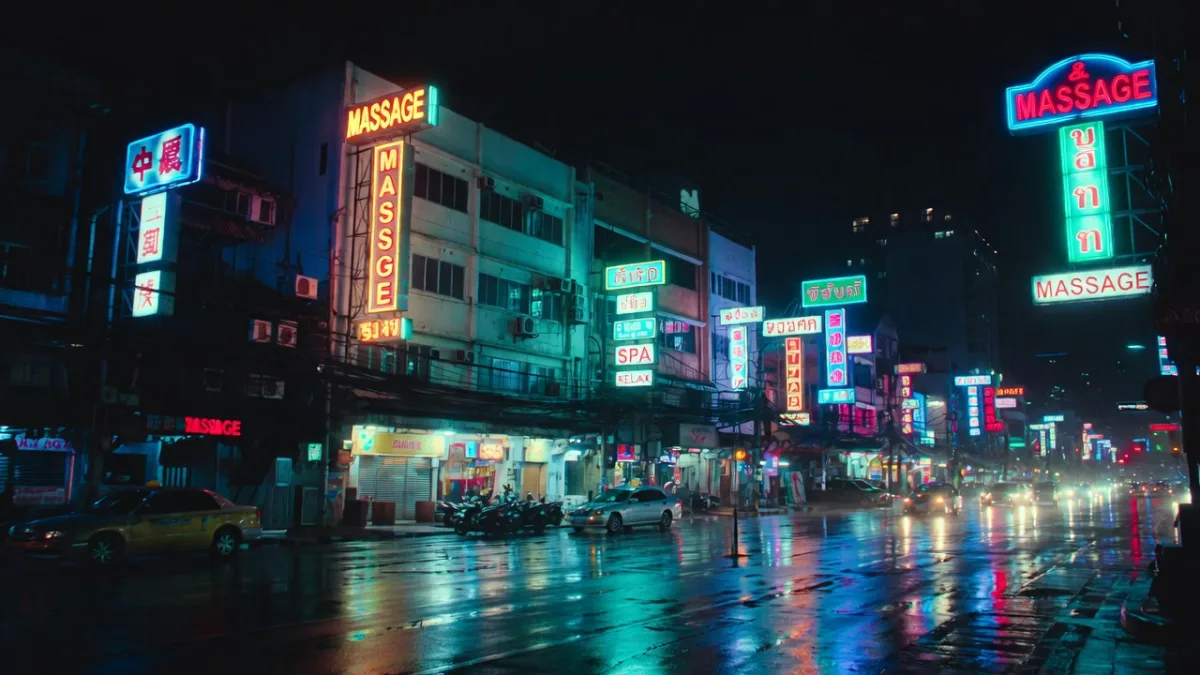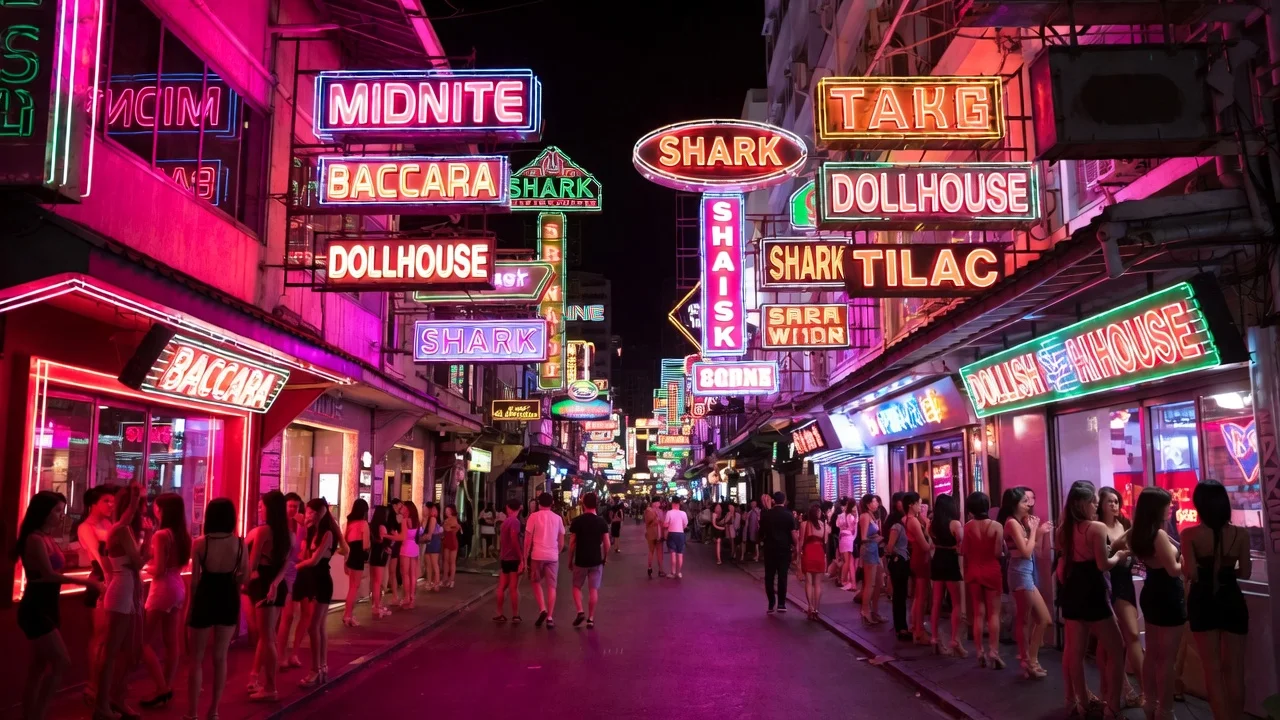
Squeezed between Sukhumvit Soi 21 and Soi 23 in the heart of Bangkok's Asoke district, Soi Cowboy (ซอยคาวบอย) packs more neon, noise, and notoriety into 150 meters than most entertainment districts manage in an entire city block. Named after a cowboy-hat-wearing African-American airman who opened a bar here in 1977, this short street has grown from a single watering hole into one of Southeast Asia's most recognizable nightlife landmarks — home to roughly 40 go-go bars, beer bars, and entertainment venues that draw millions of curious visitors every year.
But Soi Cowboy is more than its neon facade. It is a living record of Bangkok's post-Vietnam War transformation, a case study in how informal entertainment economies take root in rapidly modernizing Asian cities, and — since The Hangover Part II put it on cinema screens worldwide — a bona fide pop-culture reference point. This guide traces the full arc of Soi Cowboy's history and provides the practical information you need for a 2026 visit.
The Origins: From Soi Gold Label to Soi Cowboy (1970s)
Before it bore the name that would make it famous, the short alley connecting Asok Montri Road and Sukhumvit Soi 23 was known informally as "Soi Gold Label," after a bar of the same name that opened in the early 1970s. The Gold Label was the first double-shophouse, multi-story bar in the area, with a ground-floor lounge and what is believed to have been the alley's first go-go bar upstairs. It catered primarily to expatriates and marked the modest beginning of commercial nightlife on this quiet Sukhumvit side street.
The transformative figure arrived in 1977. T.G. "Cowboy" Edwards was a retired African-American United States Air Force serviceman who had remained in Thailand after the Vietnam War era. Tall and impossible to miss, Edwards earned his nickname from his signature outfit — a western shirt, oversized belt buckle, and ten-gallon cowboy hat that made him look as though he had stepped out of a Sergio Leone film and into tropical Bangkok. He opened the Cowboy Bar on the soi in 1977, and his larger-than-life presence quickly became the street's defining character.
The name "Soi Cowboy" was popularized — and likely coined in print — by Bernard Trink (1931–2020), the legendary New York-born columnist who wrote the "Nite Owl" column for the Bangkok World and later the Bangkok Post from 1966 to 2003. Trink chronicled Bangkok's nightlife for 37 years, and his weekly dispatches were considered required reading among the city's expatriate community. His references to "Soi Cowboy" in print gave the street its permanent identity. Trink also coined the enduring expression "TIT" — "This Is Thailand" — a phrase expats still use to explain the country's lovable contradictions.
Growth and the Sukhumvit Transformation (1980s–1990s)
Edwards' Cowboy Bar set the pace, but the man himself did not ride the wave of success for long. By several accounts from longtime Soi Cowboy residents, Edwards had a habit of "drinking up all the profits," a pattern that led to financial trouble and eventually the sale of his original bar. Undeterred, he partnered with Grant Francisco, a retired fire chief from the Vietnam War era, and opened the New Cowboy Bar on nearby Soi 22. That venture also struggled, reportedly for the same reason. Edwards eventually faded from the scene, but the name he left behind only grew in stature.
Throughout the 1980s, more bars opened along the soi, each adding its own character — live music venues, beer bars, and gradually the go-go bars that would become the street's dominant format. The growth paralleled broader changes on Sukhumvit Road. The BTS Skytrain, which began service in 1999 with Asok Station positioned directly at the western mouth of Soi Cowboy, transformed accessibility to the area overnight. The adjacent MRT Sukhumvit Station, opened in 2004, made it even easier to reach.
By the end of the 1990s, approximately 31 bars operated on Soi Cowboy, all located on the ground floor. The street had consolidated its position as one of Bangkok's three major foreign-oriented nightlife zones, alongside Patpong (which had been established since the 1960s during the Vietnam War R&R era) and Nana Plaza (which opened as a shopping center in the early 1980s before transitioning to entertainment venues).
The 2000s brought further expansion. Bars began to build upward, adding second floors — Baccara, which opened in 1999 and quickly rose to become the street's flagship venue, pioneered a multi-level format with its now-famous glass floor separating the levels. The total venue count crept toward 40 as operators converted remaining residential shophouses into commercial entertainment spaces. The opening of Terminal 21, the internationally-themed mega-mall directly across the Asok intersection, further boosted foot traffic in the area and gave visitors a convenient pre-nightlife dinner destination.
This era also coincided with the rise — and eventual demise — of Washington Square, the legendary American expat enclave at Sukhumvit Soi 22. Featured in a 2004 TIME Magazine profile titled "American Splendor," the Square was home to bars like the Texas Lone Staar (where Vietnam veterans drank under a Texas Aggie flag and a moth-eaten Cape buffalo head), the Silver Dollar, and the award-winning Bourbon Street Restaurant and Oyster Bar specializing in Cajun-Creole cuisine. Regulars called themselves "Squaronians" and included the locally celebrated characters Mekhong Kurt, Generous George, and Speedo Keith — men who had been bouncing around Bangkok for decades, swapping stories of fortunes made and squandered over bourbon. When the Square was demolished in 2013 to make way for the Emporium shopping complex expansion, many of its displaced patrons gravitated toward Soi Cowboy, further enriching the street's already colorful demographics.
Hollywood Discovers Soi Cowboy (2004–2011)
Soi Cowboy's first brush with international cinema came in 2004, when scenes from Bridget Jones: The Edge of Reason were filmed on the street. In the film, Hugh Grant's character visits a Soi Cowboy massage parlor — a scene that introduced the soi's name to mainstream Western audiences for the first time.
The bigger moment came in 2011 with The Hangover Part II, the sequel to the blockbuster comedy that transplanted its chaotic bachelor-party premise from Las Vegas to Bangkok. The film used the exterior of Cactus Bar on Soi Cowboy as the facade of the fictional "Siam Sam's," while interior scenes of the go-go bar were shot at Tilac, one of the street's oldest and most prominent venues, located at 23 Soi Cowboy. Additional interior shots were reportedly completed on a sound stage in Los Angeles.
The film grossed over US$586 million worldwide and cemented Soi Cowboy's image in global pop culture. The Hangover effect was tangible: tour operators began offering "Hangover filming location" packages, and Tilac's connection to the movie became a permanent part of its marketing identity. The street had also made appearances in Bangkok Dangerous (2008), starring Nicolas Cage, further building its cinematic reputation.
Bangkok's Three Red-Light Districts: A Comparison
Understanding Soi Cowboy requires placing it in context alongside Bangkok's other two major foreign-oriented entertainment zones. Each has a distinct character shaped by its origins, physical layout, and clientele.
Patpong, located between Silom and Surawongse Roads, is the oldest of the three, having developed in the 1960s to serve American soldiers on R&R leave from the Vietnam War. It occupies two parallel streets (Patpong 1 and 2) and is known for its night market that overlays the bar district. Patpong also houses some of Bangkok's most infamous "ping pong show" venues, which have given it a reputation for tourist traps and bill padding.
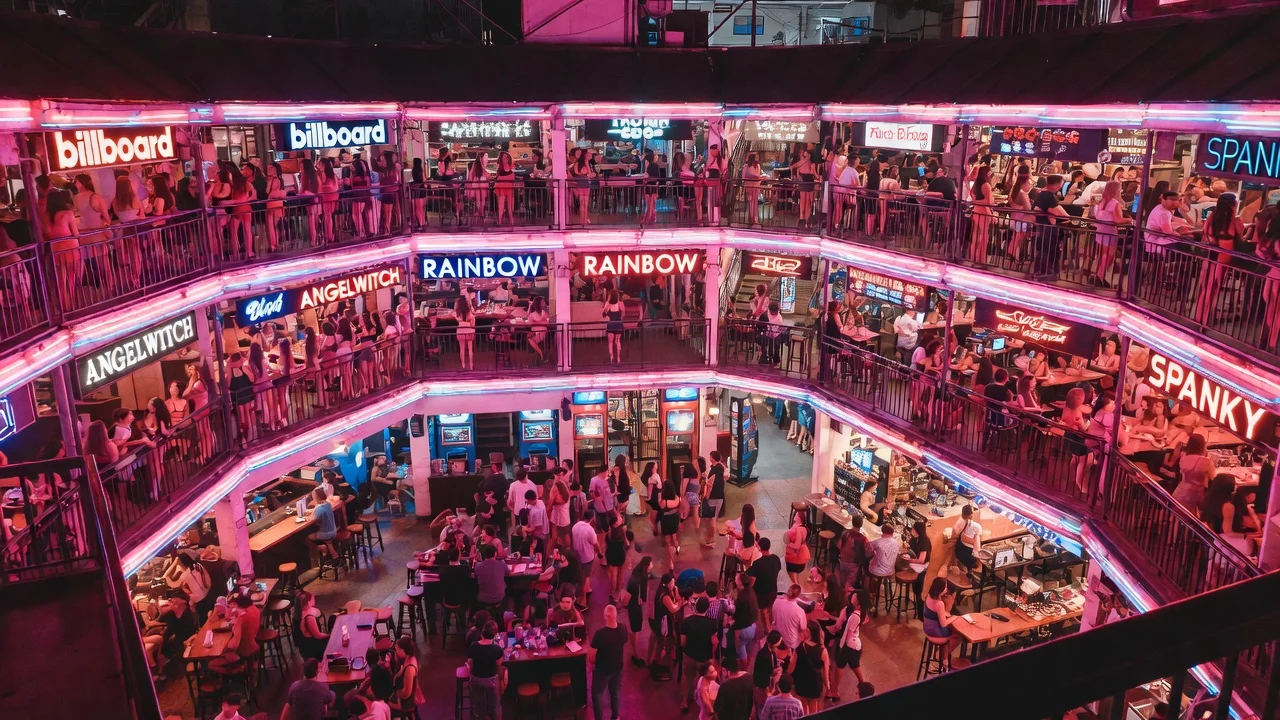
Nana Plaza, officially known as Nana Entertainment Plaza (NEP), is a three-story horseshoe-shaped complex on Sukhumvit Soi 4. With approximately 40 venues across multiple floors, it offers the highest density of go-go bars in any single structure in Bangkok. Its enclosed layout creates an intense, concentrated atmosphere that differs markedly from Soi Cowboy's open-air street setting.
Soi Cowboy sits between these two in character. Its 150-meter open-air format makes it the most walkable and visually striking of the three — the "neon tunnel" effect of illuminated bar signs on both sides of a narrow street is its signature image. It is generally considered more relaxed and tourist-friendly than Nana Plaza, with less aggressive touting than Patpong. The direct BTS and MRT access gives it a logistical advantage that neither Patpong nor Nana Plaza can match.
In Literature and Media
Beyond its Hollywood appearances, Soi Cowboy has left a significant mark on English-language literature set in Bangkok. The street features prominently in the crime fiction of Christopher G. Moore, whose long-running Vincent Calvino private investigator series uses Bangkok's nightlife districts as both setting and social commentary. Dean Barrett, another Bangkok-based novelist, referenced the nearby Washington Square milieu extensively, and the world of his characters often intersected with Soi Cowboy and its regulars.
The street also became a fixture in the extensive Bangkok nightlife blogging ecosystem that flourished in the 2000s and 2010s. Websites like Stickman Bangkok, BangkokEyes.com (which maintains a detailed historical timeline of every bar opening and closure across the city's entertainment districts since the 1990s), and numerous personal blogs documented the street's evolution in granular detail. This informal archive — part journalism, part oral history, part barroom gossip — has become an invaluable record of a social world that rarely appears in official histories.
Bernard Trink's own Nite Owl column, distributed as a separate folded supplement at hotel reception desks throughout the 1980s and 1990s, served as the original "travel guide" to Soi Cowboy for an entire generation of visitors. These physical copies were mailed by expatriates to friends around the world — pre-internet viral marketing in envelope form. When the column ended abruptly in December 2003 with no announcement or farewell, the expatriate community felt the loss acutely. Trink continued writing book reviews at the Bangkok Post until shortly before his death from a blood infection at King Chulalongkorn Memorial Hospital on October 6, 2020, at the age of 89.
The Street Elephants: A Vanished Tradition
One of Soi Cowboy's most distinctive historical features has been entirely lost to modernization. From the 1980s through the early 2000s, elephants were regularly paraded down the street as a tourist attraction. Mahouts (elephant keepers) would lead young elephants through the nightlife areas of Sukhumvit, selling bags of sugar cane and bananas to tourists who could feed and photograph the animals. The elephants wore bicycle reflectors on their tails to signal their presence to traffic after dark.
The practice was eventually banned by Bangkok authorities as part of broader animal welfare reforms and urban safety measures. The sight of an elephant navigating between neon bar signs and tipsy tourists was one of those surreal Bangkok moments that visitors either found enchanting or deeply strange — and it is now preserved only in photographs and the memories of longtime residents like Country Road's Thawatchai, who witnessed the full evolution of the street over four decades.
The Legal Framework
Like all entertainment venues in Thailand, bars on Soi Cowboy operate within a legal framework that is simultaneously strict on paper and pragmatically flexible in practice. The key legislation includes:
The Entertainment Places Act of 1966 (พระราชบัญญัติสถานบริการ พ.ศ. 2509) governs the licensing and operation of entertainment venues in Thailand. Under this law, go-go bars are classified as "Type A" entertainment places — establishments that provide entertainment involving dancing or performance by hostesses. Venue operators must obtain specific licenses, and operating hours are legally restricted to closing at 2:00 AM, though enforcement patterns vary.
The Prevention and Suppression of Prostitution Act of 1996 (พระราชบัญญัติป้องกันและปราบปรามการค้าประเวณี พ.ศ. 2539) technically prohibits prostitution in Thailand, but the law primarily targets operators and procurers rather than individual sex workers. The "bar fine" system — where a customer pays a fee to the bar for a worker to leave early — operates in a legal gray zone that has persisted for decades across all three of Bangkok's major entertainment districts. This system is neither explicitly authorized nor effectively prosecuted under current enforcement practices.
Periodic police crackdowns on Soi Cowboy — targeting underage employment, drug use, or closing-time violations — occur with varying intensity, often correlated with political cycles or high-profile incidents. The street's high visibility and tourist concentration generally incentivize a degree of self-regulation among bar operators.
COVID-19: The Darkest Chapter (2020–2022)
The COVID-19 pandemic dealt Soi Cowboy its most devastating blow in nearly five decades of operation. When Thailand declared its first national lockdown on March 18, 2020, bars, clubs, and entertainment venues were among the first businesses ordered to close. The closure was not brief.
Between March 2020 and mid-2022, nightlife venues in Bangkok were legally permitted to operate for only a handful of scattered weeks, as successive COVID waves prompted repeated shutdowns. Authorities banned alcohol sales in licensed premises — effectively closing bars even when other businesses were allowed to reopen. Soi Cowboy, which depends overwhelmingly on international tourists for its revenue, was doubly impacted by Thailand's prolonged border closures.
Thawatchai Tutthayayut, known as Tee, the longtime manager of Country Road music bar who has been a Soi Cowboy resident for over 40 years, told The Nation Thailand in March 2021 that the bar's revenue had plummeted by over 70 percent since the border closure. "What we earn nowadays is only enough for running costs — staff salary, electricity and water bills, and rent," he said. Bars across the street slashed beer prices to as low as 80 baht per bottle in a desperate bid to attract the trickle of domestic customers.
The broader toll on Bangkok's nightlife economy was severe. An estimated US$5 billion nightlife industry — spanning everything from Soi Cowboy's go-go bars to Thong Lor's upscale cocktail lounges — was effectively shuttered. Many smaller venues on Soi Cowboy closed permanently. As of early 2024, a handful of bar spaces had still not reopened. The street's recovery, however, has been strong since Thailand fully reopened to international tourism in mid-2022, and by 2025 most venues were operating at or near pre-pandemic levels.
Soi Cowboy Today: What to Expect in 2026
In 2026, Soi Cowboy operates much as it has for the past two decades — a 150-meter pedestrian strip, closed to vehicle traffic during evening hours, lined with approximately 40 venues on both sides. The venue mix includes:
Go-go bars remain the dominant format. The most prominent include Baccara (established 1999, recently renovated with a cyberpunk-noir aesthetic and its signature multi-level glass floor), Tilac (one of the oldest bars on the street, famous for its Hangover Part II connection), Shark (known for consistently attractive lineups), Dollhouse, and Long Gun. At the wilder end of the spectrum, Crazy House on Soi 23 is known for its uninhibited shows.
Beer bars and live music venues occupy the western (Asok) end of the street, including longtime fixtures like Country Road. These offer a more relaxed atmosphere for visitors who want to experience the street without entering a go-go bar.
Cockatoo operates as the street's dedicated ladyboy (kathoey) bar, offering cabaret-style entertainment. The venue has been a Soi Cowboy institution for years.
The street has also seen newer additions reflecting changing demographics. Korean-themed bars have emerged in recent years, featuring K-pop music and Korean food and drink options — a reflection of the growing number of Korean tourists visiting Bangkok.
Practical Information for Visitors
Getting There
BTS Skytrain: Asok Station (Exit 3) deposits you directly at the western entrance of Soi Cowboy. The BTS runs until 1:00 AM on weekdays and 2:00 AM on weekends as of 2026.
MRT Subway: Sukhumvit Station (Exit 2) is a short walk from the same end of the street.
Grab/Taxi: Reliable for late-night return trips after public transport stops. The pickup zone on Sukhumvit Road works better than trying to flag a taxi directly on the soi.
Walking from Nana Plaza: Approximately 15 minutes along Sukhumvit Road. The Sukhumvit Skywalk extension allows part of this journey to be done above street level.
Hours and Timing
Most bars open between 7:00 PM and 8:00 PM. Happy hour promotions typically run until 9:00 or 10:00 PM. Peak activity is between 10:00 PM and 1:00 AM. Official closing time is 2:00 AM, though some bars push to 2:30 or 3:00 AM. Weekends are significantly busier. Age restriction signs at both entrances indicate a minimum age of 20 years.
Prices (2026)
Standard beer prices range from 120–200 THB depending on the venue. Lady drinks (buying a drink for a bar worker) typically cost 200–260 THB. Go-go bar entry is generally free — revenue comes from drink sales. Bar fines, where applicable, range from 700–1,200 THB depending on the venue and time of night.
Safety Tips
Soi Cowboy is generally considered safe for tourists, with visible police presence and security checks. However, standard precautions apply:
Confirm drink prices before ordering, and photograph the menu if possible — the price-switching scam (showing one menu at ordering and a different one at payment) does occur at a few venues. Stick to well-known bars like Baccara, Tilac, Shark, and Dollhouse for transparent pricing. Be cautious with personal belongings in crowded areas. If taking a taxi, use a meter or Grab rather than negotiating a flat fare.
Nearby Landmarks
Terminal 21, the internationally-themed shopping mall, sits directly across from the western entrance of Soi Cowboy and is a popular starting point for evening plans — dinner at Terminal 21 followed by a walk through the soi is a common visitor pattern. The Pullman Bangkok Grande Sukhumvit Hotel is adjacent to the eastern end of the street.
The Future of Soi Cowboy
Soi Cowboy exists in a state of productive tension between preservation and development pressure. The Asoke intersection is one of Bangkok's highest-value real estate corridors, and the land occupied by low-rise bar buildings surrounded by luxury hotels and mega-malls represents an obvious development target. Yet Soi Cowboy has survived multiple waves of Bangkok's relentless modernization — the Asian Financial Crisis of 1997, the SARS outbreak of 2003, repeated political upheavals, and the COVID-19 pandemic.
The street's durability is partly economic (it generates significant tourism revenue in an area that already benefits from enormous foot traffic via Terminal 21 and the BTS/MRT interchange) and partly cultural (it has become a defining element of Bangkok's global brand, appearing on countless "must-see" lists and travel documentaries). The Thai government has shown no indication of pursuing the kind of forced closures that eliminated Sukhumvit Square in 2003, and the Entertainment Places Act continues to provide a legal operating framework for the venues.
Whether you visit to photograph the neon, to experience a go-go bar, or simply to walk through one of Asia's most famous streets, Soi Cowboy delivers an experience that is uniquely, irreducibly Bangkok — 150 meters of organized chaos that T.G. "Cowboy" Edwards could never have imagined when he hung up his hat sign in 1977.
Sources & References
- Bernard Trink — Wikipedia biography; "Nite Owl" column, Bangkok World / Bangkok Post (1966–2003)
- "Post legend Bernard Trink dies at 89" — Bangkok Post, October 11, 2020
- "Soi Cowboy's rough ride through Covid-19" — The Nation Thailand, March 2021
- "Bangkok's US$5 billion nightlife economy" — South China Morning Post, October 2021
- BangkokEyes.com historical nightlife timeline and T.G. Edwards profile
- Thailand Entertainment Places Act of 1966 (พ.ร.บ.สถานบริการ พ.ศ. 2509)
- Thailand Prevention and Suppression of Prostitution Act of 1996 (พ.ร.บ.ป้องกันและปราบปรามการค้าประเวณี พ.ศ. 2539)
- Washington Square (Bangkok) — Wikipedia; TIME Magazine "American Splendor," July 2004
- Christopher G. Moore — Vincent Calvino series; Dean Barrett — Bangkok fiction
- IMDB — The Hangover Part II (2011), filming locations: Tilac and Cactus Bar, Soi Cowboy
- Tourism Authority of Thailand (TAT) visitor statistics, 2017–2024