There's a moment — usually about forty-eight hours into your first trip to Bangkok — when someone mentions "soapy massage" and the table goes quiet. Half the group pretends they didn't hear it. The other half leans in. It's one of those subjects that every guidebook dances around but never quite explains. So let's do what guidebooks won't: talk about Thailand's adult massage industry honestly, historically, and without the usual pearl-clutching.
Because whatever your personal stance on the matter, the adult massage trade is woven into the economic, cultural, and legal fabric of modern Thailand. Ignoring it doesn't make it disappear. Knowing how it works, however, might keep you safer, smarter, and — if nothing else — better informed than the guy at the hotel bar pretending he's never heard of Ratchadaphisek Road.
A Brief History: From R&R to Ratchada
To understand how Thailand became synonymous with adult massage, you have to rewind to the 1960s. During the Vietnam War, the Thai government agreed to host American military personnel for "Rest and Recreation" — or R&R, as the servicemen called it. The arrangement was straightforward: GIs on leave needed somewhere to decompress, and Thailand needed dollars. The number of sex workers in the country reportedly surged from around 20,000 in 1957 to an estimated 400,000 by 1964. The infrastructure that would later become the adult massage industry was being built, one makeshift bar and bathhouse at a time.
The Entertainment Places Act of 1966 was Thailand's attempt to regulate what was already happening. The law didn't explicitly permit sexual services, but it created a licensing framework for "entertainment venues" — including establishments offering bathing, steaming, and massage. The Act introduced a peculiar colour-coded badge system: staff providing sexual services wore red circular disks with identification numbers, while non-sexual service staff wore blue ones. It was regulation by euphemism — the government acknowledging reality while officially pretending it was something else.
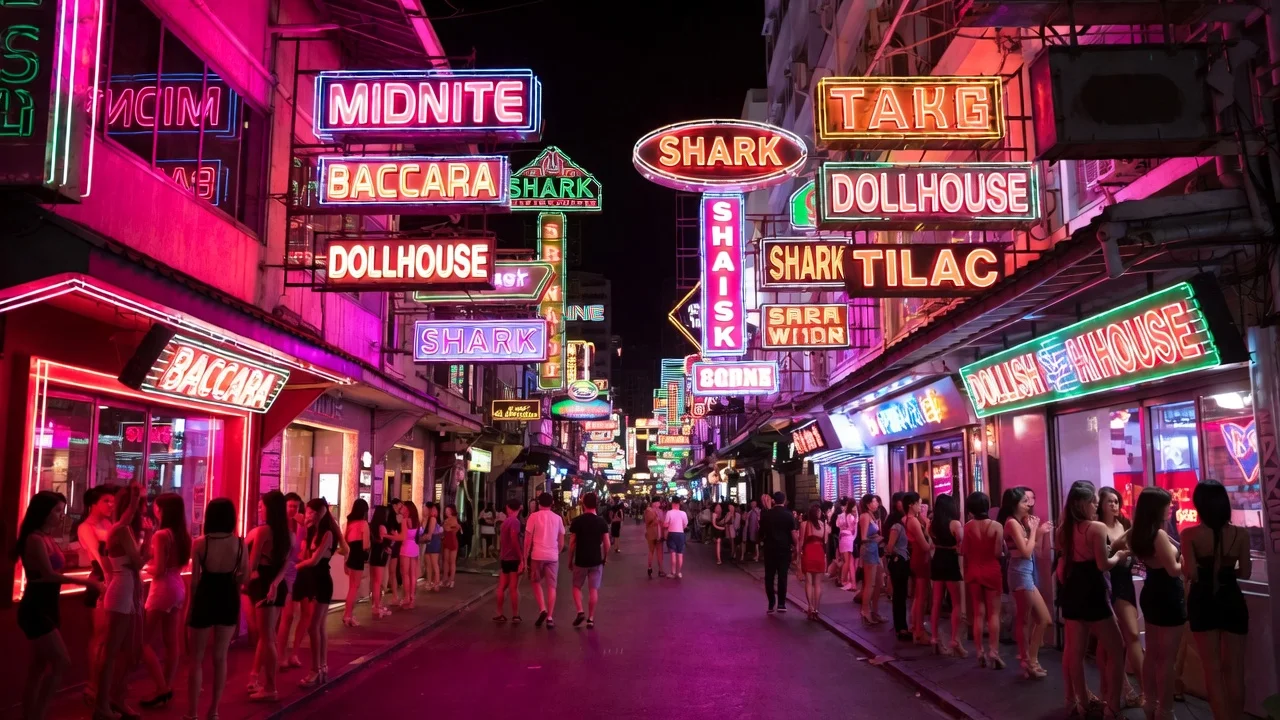
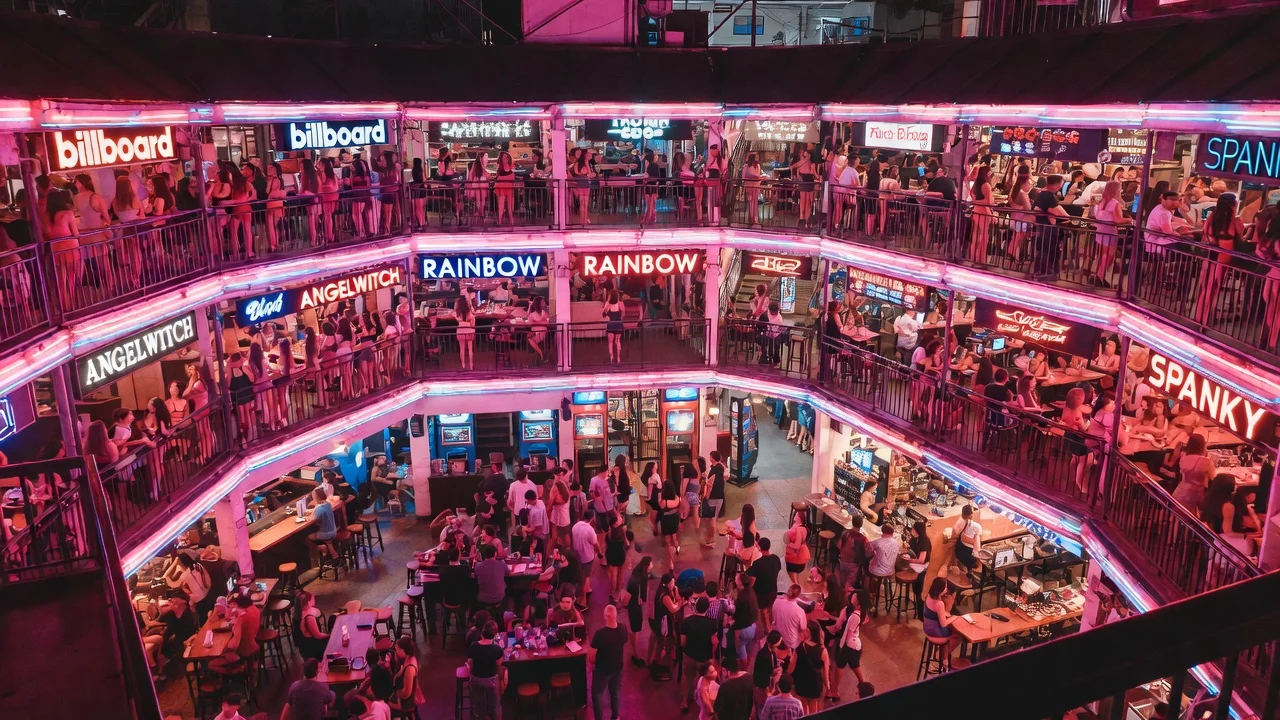
By the 1970s and 1980s, the massage parlour industry had crystallised into something recognisable. Large establishments — some occupying entire multi-story buildings — began appearing along Ratchadaphisek Road and New Phetchaburi Road in Bangkok. These weren't back-alley operations. They were palatial, neon-lit complexes with names like Copacabana, Emmanuelle, and Poseidon — lobbies that looked more like five-star hotels than anything your travel agent would recommend.
The Fishbowl: How It Actually Works
The mechanics of a traditional Thai soapy massage parlour haven't changed dramatically since the 1980s. Upon entering, you find yourself in a dimly lit lobby facing a large glass partition — the "fishbowl." Behind the glass, anywhere from fifty to several hundred women sit in tiered seating, dressed in evening gowns, each wearing a numbered badge. A manager — known as the papasan or mamasan — assists you in selecting a number.
Some establishments also offer "sideline" girls — women sitting in the open lobby area whom you can approach and speak with directly before making your choice. The distinction matters: fishbowl selections are typically less expensive, while sideline girls command premium rates.
After selection, you're escorted to a private room equipped with a bathtub or jacuzzi and a massage mat. The session, usually lasting 90 minutes to two hours, begins with bathing and proceeds through various massage techniques. The specifics vary by establishment and arrangement, but the general format has remained remarkably consistent for over four decades.
Soapy vs. Nuru: Know the Difference
If "soapy massage" is Thailand's native contribution to adult entertainment, nuru is the Japanese import that's reshaped the market since the 2010s.
Soapy massage — known in Thai as sathan ap op nuat (สถานอาบอบนวด), literally "bathing and massage places" — originated in Bangkok's large parlour scene. The format centres on a bathtub filled with warm, soapy water, followed by a body-to-body massage on an air mattress. It's a distinctly Thai institution, refined over decades in the Ratchadaphisek and Huai Khwang districts.
Nuru massage takes its name from the Japanese word nuru (ぬる), meaning "slippery." The practice emerged from Japan's soapland bathhouses — reportedly in the Kawasaki red-light district during the late 20th century — as a response to Japan's 1956 Anti-Prostitution Law, which prohibited paid intercourse but permitted other forms of physical contact. The signature element is a translucent, water-based gel derived from nori seaweed extract, applied to both parties to create an extremely slippery, full-body sliding experience on a vinyl or air mattress.
Nuru arrived in Bangkok around 2010 and quickly carved out a premium niche. Modern Bangkok establishments — places like BKK Vice, Daisy Dream, and 102 Massage — often offer both soapy and nuru options, with nuru typically commanding higher prices due to the specialised gel and equipment involved. Where a soapy session might start at ฿2,000–3,000, a comparable nuru session often begins at ฿2,500–4,000.
The Legal Grey Zone
Here's where it gets messy. Thailand's legal setup around adult massage runs on deliberate ambiguity.
Three pieces of legislation govern the space. The Entertainment Places Act of 1966 regulates massage parlours as entertainment venues, requiring licensing but not explicitly permitting sexual services. The Prevention and Suppression of Prostitution Act of 1996 criminalises solicitation and operating prostitution establishments, with penalties ranging from fines to imprisonment. And the Criminal Code (amended 2003) prohibits earning income from prostitution.
In practice, as one legal analysis notes, massage parlours and karaoke bars can be registered as normal, legal businesses. When arrests occur at such premises, police typically treat the act as an exchange between the worker and the client — one to which the business owner was ostensibly not a party. It's a legal fiction that allows the industry to operate in a grey zone: massage is legal, sexual services are not, and the line between them is policed selectively.
The most dramatic illustration of this grey zone came in 2003, when Chuwit Kamolvisit — then Bangkok's biggest massage parlour owner, controlling six massive venues employing roughly 600 women each — was arrested and subsequently revealed that he'd been paying police an average of US$160,000 per month in bribes over ten years. His six parlours near Ratchadaphisek Road — Copacabana, Victoria's Secret, Honolulu, Hi Class, Emmanuelle, and Julianna — operated openly as businesses where, as he later told reporters, prices ranged from ฿3,000 to ฿6,000 per two-hour session. Several top police officers were suspended or demoted following Chuwit's revelations. He went on to become a politician, winning a seat in parliament, and later an anti-corruption crusader — though he was diagnosed with stage 3 liver cancer in 2023.
The Numbers: An Industry in the Shadows
Precise economic data on Thailand's adult massage sector is, for obvious reasons, difficult to obtain. The industry operates in a legal grey area, and its revenues don't appear in official statistics. But the adjacent numbers tell a story.
Thailand's broader wellness and spa economy generated approximately ฿670 billion (US$20.7 billion) in 2025, according to the Ministry of Tourism and Sports. The country is home to over 92,800 wellness tourism-related businesses, with 28,203 direct service providers including hospitals, clinics, spas, and wellness centres generating ฿220 billion in revenue. The spa sector specifically has grown by 9.4%, reaching a total value of US$1.6 billion.
These figures cover legitimate therapeutic massage — but the line between "wellness spa" and "adult entertainment venue" is porous. In 2022, the Health Business Division reported 10,077 registered health establishments with 190,000 registered service providers offering massage and spa services. The actual number of establishments offering adult services — unlicensed, semi-licensed, or operating under entertainment venue permits — is unknown but certainly adds significantly to the total.
What we do know: before COVID-19, the Bangkok Post estimated that popular massage venues in Bangkok could earn over ฿1 million per day, and that the underground sex industry generated revenue exceeding ฿100 billion annually — none of it taxed. A single establishment like Nataree Massage on Ratchadaphisek Road, which operated for 40 years before being raided in 2017, was reportedly generating approximately US$539,000 per month.
City-by-City Guide: Where the Parlours Are
Bangkok
Bangkok remains the undisputed capital of Thailand's adult massage industry, with three distinct zones:
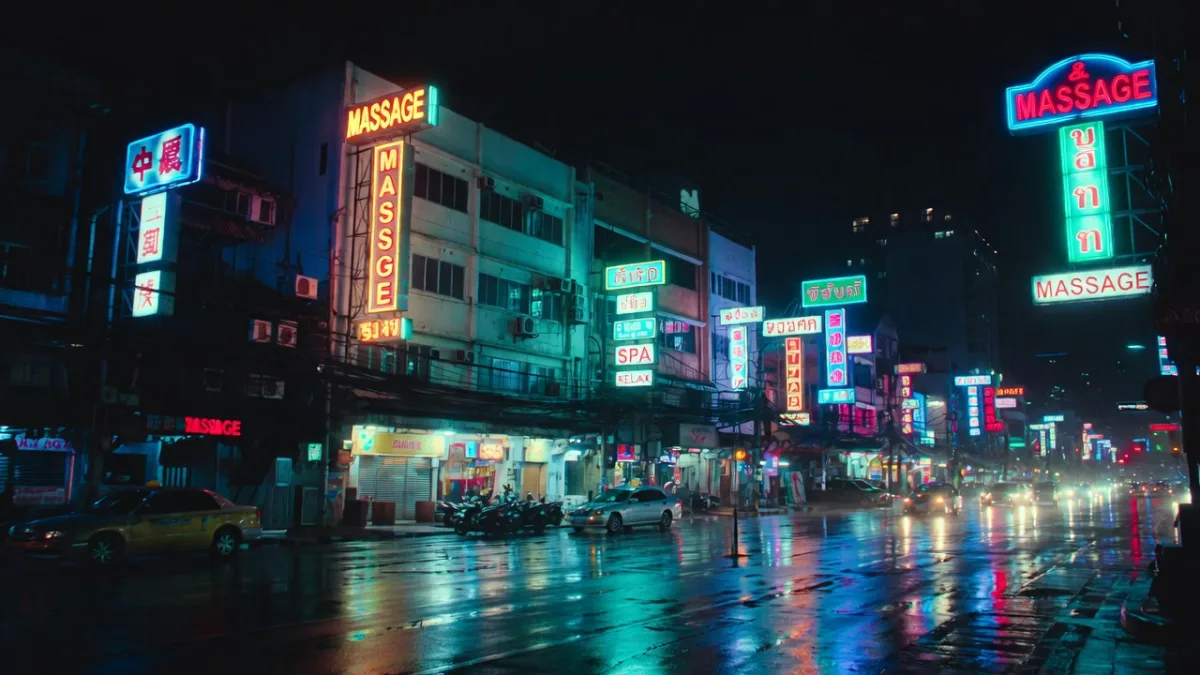
Ratchadaphisek Road / Huai Khwang: This is ground zero for the traditional Thai soapy massage experience. The stretch between Rama IX Road and Sutthisan features the largest, most established parlours — multi-story complexes that primarily serve wealthy Thai and East Asian clientele. Getting there is easy: take the MRT to Huai Khwang station (Exit 3) and walk. Names like Poseidon, Maria, and Emmanuelle dominate the neon-lit streetscape. Expect to pay ฿2,000–6,000 depending on the establishment and your selection. Be aware that some venues charge foreigners a surcharge of ฿600–1,200.
Sukhumvit / Nana area: The more tourist-oriented zone. Annie's Soapy Massage, opened in 1972, claims to be the longest-running licensed soapy massage parlour in the Nana/Sukhumvit area. Newer nuru-focused establishments like Daisy Dream (Sukhumvit Soi 33), BKK Vice (near BTS Phrom Phong), and 102 Massage (Sukhumvit 24) cater primarily to international visitors with more modern facilities and English-speaking staff. Prices start at ฿2,000 and can exceed ฿5,000 for premium services.
New Phetchaburi Road: Running parallel to Ratchadaphisek, this strip hosts another cluster of large Thai-style parlours. Less frequented by Western tourists, it's popular with local Thai and Asian clientele.
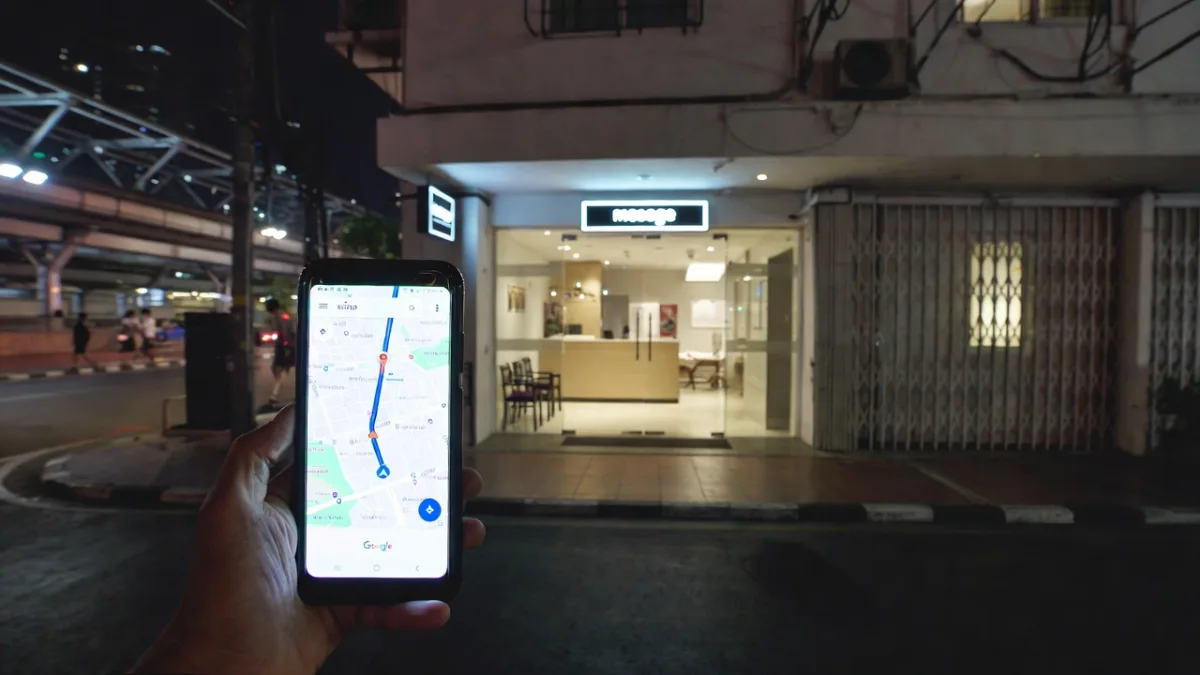
Not so long ago, finding a reputable nuru or soapy massage venue in Bangkok meant wandering unfamiliar streets at night, relying on taxi drivers with commission deals, and occasionally walking into situations that ranged from disappointing to straight-up dodgy. Scams, overcharging, and bait-and-switch operations were — and to some extent still are — occupational hazards of the uninformed visitor. But the internet flipped that. Today, you can research venues, compare prices, and read recent reviews — sites now list nuru massage parlours with photos, pricing, and directions from the nearest BTS station, all before you ever leave your hotel. It's not exactly the Wild West anymore — though knowing what you're walking into still helps.
Pattaya
Pattaya's adult massage scene is more diffuse than Bangkok's, spread across the city rather than concentrated in a single district. Soapy parlours cluster along Second Road, Soi Buakhao and the areas near Walking Street. The city also has plenty of smaller "oil massage" shops offering various levels of service. Prices tend to be 10–20% lower than Bangkok equivalents, though quality varies more widely. The Sabai Dee and Rasputin parlours are among the better-known larger establishments.
Chiang Mai
Chiang Mai's adult massage scene is way smaller and quieter than Bangkok's or Pattaya's. A handful of soapy massage venues operate in the Changklan Road and Night Bazaar area, but the city's cultural identity as Thailand's "Rose of the North" means that large-scale parlour operations are less visible. Most adult massage services in Chiang Mai operate through smaller independent shops rather than the mega-complexes found in Bangkok.
Phuket
Patong Beach is the centre of Phuket's adult entertainment, including massage services. Bangla Road and the surrounding soi network host numerous massage establishments of varying types. Like Pattaya, the scene is more fragmented — smaller operations rather than Bangkok-style complexes. Prices are comparable to Pattaya, sometimes slightly higher during peak tourist season (November–February).
COVID-19: The Great Reset
The pandemic devastated Thailand's massage industry — both legitimate and adult. When the first lockdown hit in March 2020, the Thai Spa Association reported that over 80% of spa and Thai massage businesses closed, with job losses exceeding 200,000. The soapy massage parlours on Ratchadaphisek went dark for months.
When entertainment venues were finally permitted to reopen on July 1, 2020 — the fifth phase of lockdown easing — the neon lights on New Phetchaburi Road flickered back to life and parking areas filled immediately. But the recovery was uneven and fragile, with subsequent lockdowns in 2021 causing further damage.
The pandemic accelerated several trends: smaller, independent operators struggled to survive, potentially opening the door to foreign (particularly Chinese) investment in the sector. Meanwhile, the newer nuru-focused establishments in Sukhumvit — smaller, more modern, and less dependent on the traditional fishbowl model — adapted more quickly than the massive Ratchadaphisek complexes. Post-COVID, the Global Wellness Institute reported that Thailand's wellness tourism sector grew by over 120%, though it hadn't yet fully returned to pre-pandemic levels.
Safety & Practical Advice
Whether you're a curious first-timer or an experienced visitor, here's what actually matters:
Health considerations: Reputable establishments maintain clean facilities, and sessions typically begin with thorough bathing. Standard safer-sex practices apply. The risk of HIV or other STIs from massage activities without fluid exchange is classified as very low by medical authorities, but use protection for any sexual contact. Bring your own if you want certainty about quality.
Scams and overcharging: The "foreigner surcharge" is real at some Thai-oriented establishments, particularly on Ratchadaphisek. Confirm all prices before proceeding. Never pay an "entry fee" — legitimate parlours don't charge one. If a taxi driver takes you to a parlour, expect a commission to be added to your bill. Use the MRT to Huai Khwang instead.
Legal awareness: While enforcement against clients is extremely rare, be aware that prostitution is technically illegal in Thailand. The practical risk to visitors is close to zero, but knowing the law doesn't hurt. Never, under any circumstances, engage with anyone who appears to be underage — the penalties are severe and enforced, including under extraterritorial laws that may apply in your home country.
Etiquette: Treat staff with respect. These are people doing a job, and basic human decency goes a long way. Tipping is customary — ฿300–500 is standard for good service. Don't haggle aggressively over prices. If you're uncomfortable with the situation at any point, you can leave.
What to expect on price: Budget ฿2,000–4,000 for a standard session at a mid-range establishment. Premium venues and nuru services can run ฿4,000–8,000+. Tips are additional. ATMs are plentiful near major parlour areas, but carrying cash is advisable as not all establishments accept cards.
If you want the full rundown on Bangkok's nightlife safety, read our guide to Thailand nightlife scams. For current prices across the board, see our Thailand Nightlife Prices 2026.
The Future: Regulation or More of the Same?
In 2025, proposed amendments to the Entertainment Places Act were put forward — the first real update in over fifty years. The draft aims to tighten rules, raise penalties for illegal activity, and drag the law into the current century. Whether any of this will actually change how the adult massage industry runs, or just stack another layer of paperwork on top of selective enforcement, is anyone's guess.
Meanwhile, there's an ongoing debate about whether Thailand should follow models like New Zealand's 2003 Prostitution Reform Act and fully decriminalise sex work. Advocates — including long-standing NGOs like the Empower Foundation — argue that decriminalisation would improve worker safety, enable health monitoring, and bring billions in underground revenue into the tax system. Opponents cite moral and cultural concerns.
Look — the industry isn't going anywhere. The combination of tourist demand, economic incentive, and a legal framework that enables rather than prevents has proven pretty much bulletproof — surviving wars, coups, financial crises, and a global pandemic. The question isn't whether Thailand's adult massage industry will continue to exist, but whether it will be forced to evolve.
As Anthony Bourdain might have said: you don't have to like everything you see when you travel. But closing your eyes to it doesn't make you a better person — just a less informed one.