If Thailand's nightlife industry has a signature product — something that exists nowhere else in quite the same form — it's the soapy massage. Not because the concept of washing someone is uniquely Thai, but because only Thailand turned it into a fully realized industry with its own architecture, vocabulary, and social hierarchy.
Origin and Development
The soapy massage, known in Thai as ab ob nuat (อาบอบนวด, literally "bathe, steam, massage"), emerged in Bangkok during the late 1970s and early 1980s as an evolution of simpler bathhouse services. The format was influenced by Japan's soapland establishments (which themselves evolved after Japan's 1958 Anti-Prostitution Act restricted traditional brothels), but the Thai version developed its own distinct character.
By the mid-1980s, purpose-built soapy massage parlours had become major businesses in Bangkok, with multi-story facilities accommodating hundreds of clients simultaneously. The industry concentrated along New Phetchaburi Road in the Huai Khwang district — a location that remains the epicenter of Bangkok's soapy massage scene to this day.
The Thai soapy massage is distinguished from its international counterparts by several features: the scale of the establishments (some employing over 100 therapists), the formalized selection system, the elaborate room categories, and the cultural norms governing the interaction between client and therapist.
The Fishbowl System
The most iconic feature of the traditional Thai soapy massage parlour is the "fishbowl" — a large, glass-fronted room visible from the lobby where massage therapists sit in rows, wearing evening gowns and numbered badges. The glass creates a one-way viewing experience: clients can see the therapists, but interaction is limited to selecting a number.
This system emerged as a practical solution to a logistical challenge — how to allow large numbers of clients to choose from large numbers of therapists efficiently. The numbered badge system removes the need for awkward conversation and allows the floor manager (papasan or mamasan) to coordinate scheduling.
Not all modern establishments use the fishbowl format. Many venues, particularly newer and more upscale ones, have shifted to a "sideline" model where therapists sit in a lounge area and can be approached for conversation before selection. Some premium venues offer digital lineups through messaging applications, allowing clients to view photos and profiles before arriving.
How a Soapy Massage Session Works
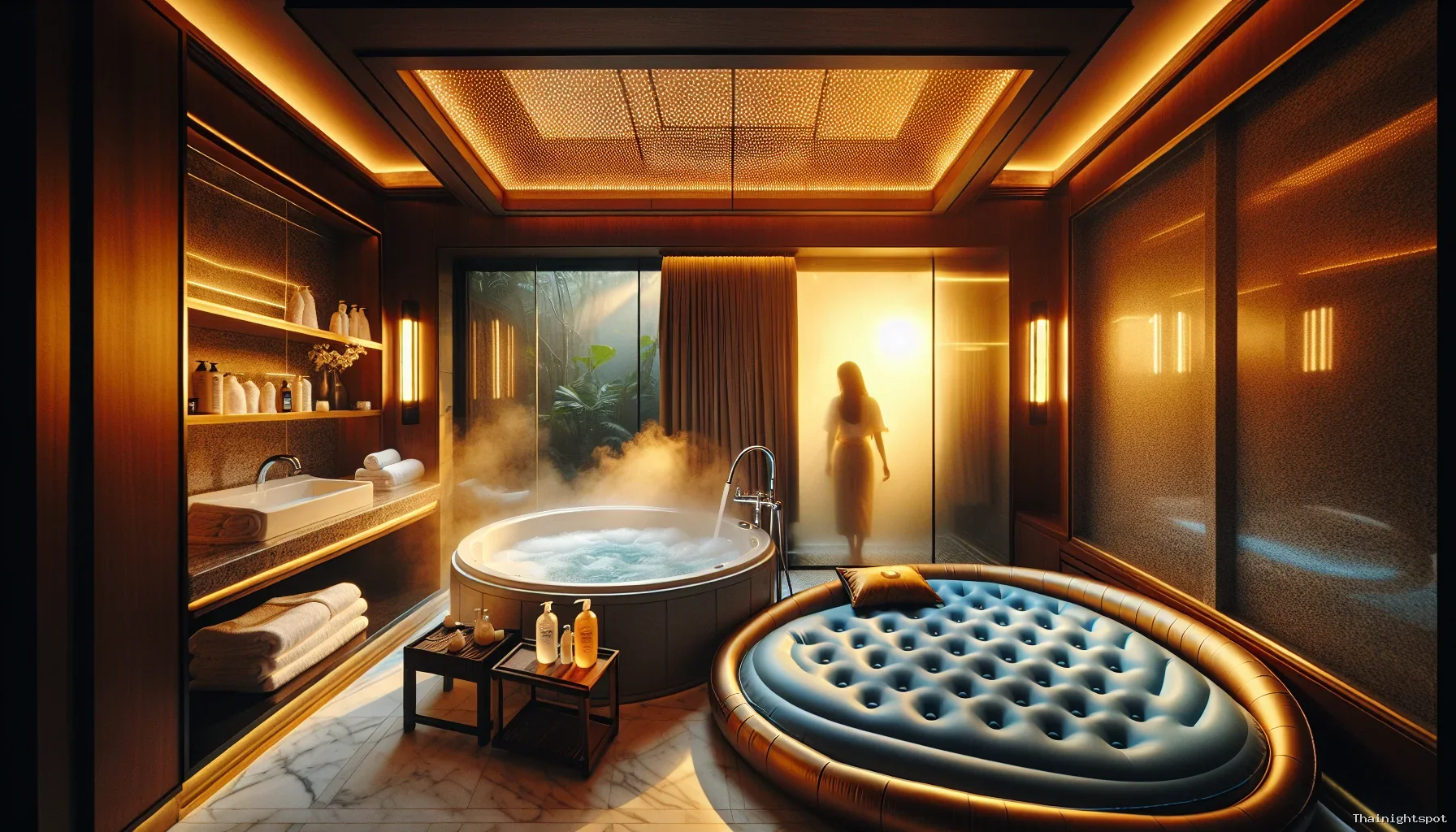
A typical soapy massage session follows a well-established sequence. After selecting a therapist, the client is escorted to a private room — the grade of which depends on the price tier. Rooms range from basic (shower, mattress, bed) to VIP suites (jacuzzi, sauna, lounge area, sound system).
The session begins in the bathing area. The therapist fills the bathtub or jacuzzi with warm water and assists the client with bathing — this initial phase serves both a hygiene and relaxation function. Following the bath, the client moves to an inflatable or vinyl air mattress on the floor.
The therapist applies generous amounts of soapy water or specialized body wash to both herself and the client, then uses her entire body — including chest, arms, legs, and torso — to perform a sliding, full-body massage. This body-to-body contact, facilitated by the soapy lubrication, is the defining characteristic of the soapy massage experience. The session concludes on the bed.
Total session duration is typically 90 minutes to two hours, though some establishments offer extended packages.
Where to Find Soapy Massage in Thailand
Bangkok
The primary concentration of soapy massage parlours in Bangkok is the Huai Khwang district, particularly along New Phetchaburi Road and Ratchadaphisek Road. Major establishments in this area operate in large, purpose-built buildings that are difficult to miss. The area is accessible via MRT Huai Khwang station.
A secondary cluster exists in the Sukhumvit area, particularly around Nana (Soi 4) and lower Sukhumvit. Annie's, located on Soi 4 near Nana Plaza, claims to be the longest-running licensed soapy massage parlour in the Sukhumvit area, having operated since 1972. Newer boutique-style venues offering both soapy and nuru massage have proliferated along Sukhumvit Soi 24 and Soi 33 in recent years.
Pattaya
Pattaya's soapy massage establishments are concentrated along Soi Buakhao and North Pattaya Road. While fewer in number than Bangkok, Pattaya's venues tend to be large-scale operations catering primarily to foreign visitors and domestic tourists from Bangkok.
Other Cities
Chiang Mai, Phuket, and Hat Yai all have soapy massage establishments, though significantly fewer than Bangkok or Pattaya. These tend to cater primarily to domestic Thai and Asian (particularly Chinese, Japanese, and Korean) clientele.
Pricing Structure (2026)
Soapy massage pricing in Bangkok follows a tiered system based on therapist classification and room type:
Sideline therapists (seated in the lounge, approachable): 2,000-3,500 baht
Fishbowl therapists (displayed behind glass): 2,500-5,000 baht
Model/star therapists (premium selection): 5,000-8,000+ baht
VIP room upgrade: 500-2,000 baht additional
Some establishments charge a surcharge of 600-1,200 baht for foreign clients, a practice that is declining but not yet eliminated. Prices in Pattaya tend to be 10-20% lower than Bangkok for comparable service levels.
Tips are customary but not mandatory. A typical tip ranges from 300-1,000 baht depending on satisfaction and the overall price tier.
Cultural Context
The soapy massage occupies a unique position in Thai society. Unlike street-level sex work, major soapy massage parlours operate as legitimate licensed businesses. They pay corporate taxes, provide employee benefits in some cases, and maintain corporate governance structures. Several of Bangkok's most established venues have operated continuously for decades.
Domestic Thai clients make up a significant portion of the customer base — particularly at the large Huai Khwang establishments, where the clientele skews heavily Thai and East Asian. The common Western perception that soapy massage is primarily a tourist phenomenon is inaccurate; it is deeply embedded in Thai male social culture, often associated with corporate entertainment and social bonding.
During the COVID-19 pandemic, soapy massage parlours were among the last entertainment venues to reopen. When the fifth phase of Thailand's lockdown lifting came into effect on July 1, 2020, the return of customers to New Phetchaburi Road venues was immediate and substantial, as reported by Nation Thailand.
Related: Thailand's Massage Industry Overview | Nuru Massage Guide