Before Thailand became famous for a different kind of massage entirely, it had already given the world one of the most sophisticated bodywork systems ever developed. Traditional Thai massage — nuad thai — is not a spa luxury or a tourist novelty. It is a 2,500-year-old medical tradition that survived wars, colonialism, and the relentless pressure of modernization to earn recognition from UNESCO as one of humanity's intangible cultural treasures.
Origins: The Father Doctor
Thai massage tradition attributes its origin to Shivago Komarpaj (Jivaka Kumar Bhaccha), a physician described in Pali Buddhist texts as a contemporary of Gautama Buddha and personal doctor to the Sangha (monastic community). According to tradition, Shivago's medical knowledge traveled from India to Southeast Asia along with Buddhism itself, arriving in the territory that would become Thailand sometime during the first millennium CE.
The historical evidence for this direct lineage is limited, but the philosophical framework is well documented. Thai massage integrates elements from at least three distinct traditions: Indian Ayurvedic medicine (particularly the concept of vital energy points), Chinese medicine (acupressure and meridian theory), and indigenous Southeast Asian healing practices. The synthesis of these influences into a uniquely Thai system occurred over centuries, with Buddhist temples serving as the primary repositories and transmission centers for the knowledge.
Wat Pho: The Living Encyclopedia
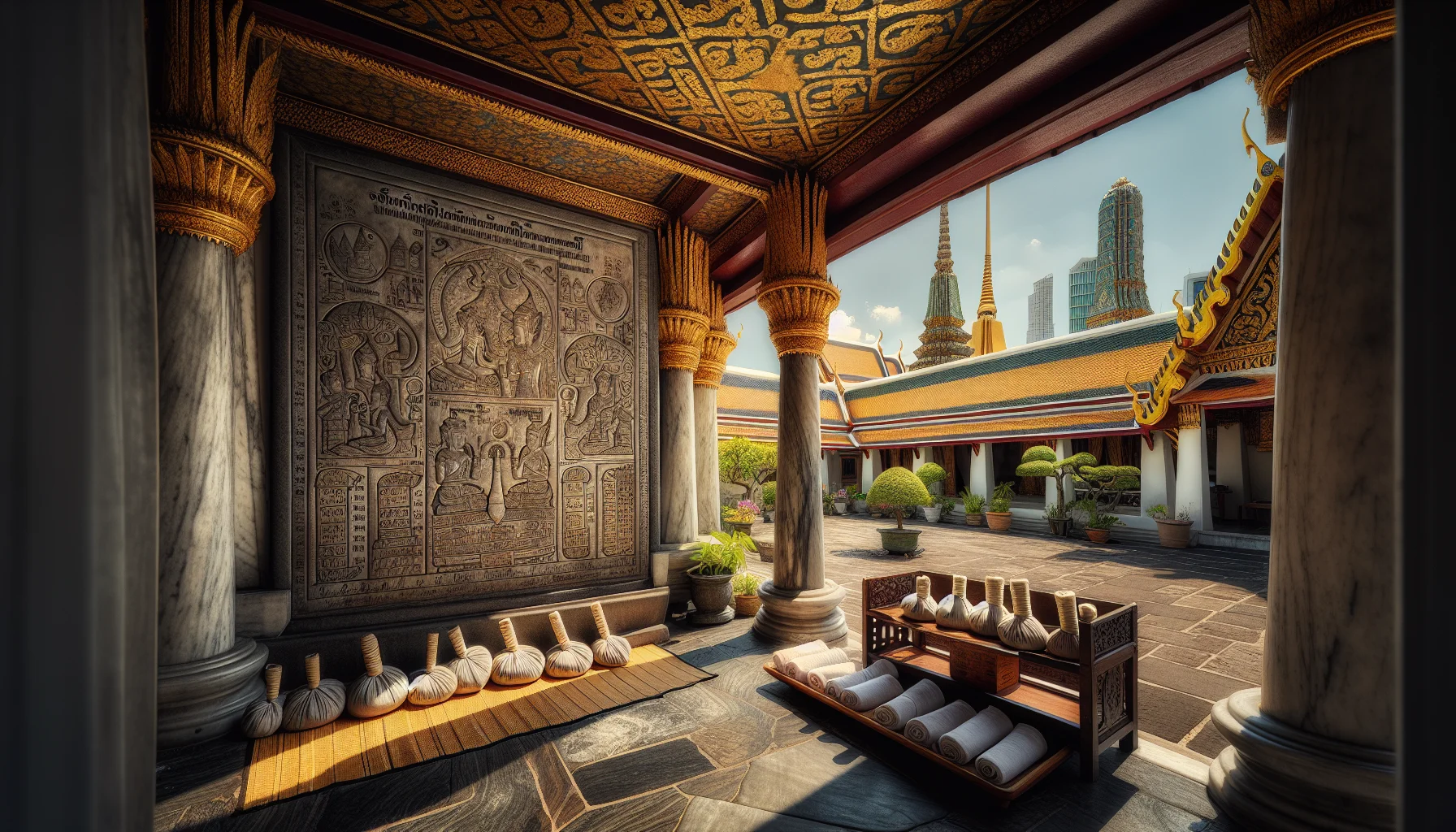
The most important single site in the history of Thai massage is Wat Pho (Wat Phra Chetuphon Wimon Mangkhalaram), Bangkok's oldest and largest temple complex. While the temple dates to the 16th century, its role as a center of medical knowledge was formalized by King Rama III (reigned 1824-1851), who commissioned an extensive restoration that included the creation of stone inscriptions and illustrations depicting the body's energy lines and pressure points.
These inscriptions — carved into marble plaques and displayed in the temple grounds — represent the most comprehensive visual record of traditional Thai medical theory. They depict the sen (energy lines) that form the theoretical foundation of Thai massage, mapping pathways through the body along which life energy (prana or lom) is believed to flow. Traditional Thai massage theory identifies ten principal sen lines, each associated with specific organs and bodily functions.
In 1955, the Wat Pho Thai Traditional Medical and Massage School was formally established, creating an institutional framework for training that had previously been transmitted informally from master to student. The school remains the gold standard for Thai massage certification, offering courses ranging from 30-hour introductory programs to comprehensive 800-hour professional training.
UNESCO Recognition
On December 12, 2019, at a meeting in Bogota, Colombia, UNESCO inscribed nuad thai on its Representative List of the Intangible Cultural Heritage of Humanity. The inscription recognized Thai massage as a practice that "provides health benefits and has been part of Thai identity for centuries," noting its role in community health, its system of formal and informal knowledge transmission, and its integration with Thai Buddhist culture.
The UNESCO recognition was the culmination of years of effort by the Thai government and cultural organizations to formalize the distinction between traditional Thai massage as a medical and cultural practice, and the commercial massage industry that uses similar terminology but serves fundamentally different purposes.
Techniques and Principles
Traditional Thai massage is performed on a mat on the floor, with the recipient fully clothed in loose, comfortable garments. Unlike Western massage modalities that rely primarily on kneading muscles, Thai massage employs a combination of rhythmic pressing along the sen lines, deep stretching (often described as "assisted yoga"), and joint mobilization.
The practitioner uses not only hands and fingers but also thumbs, elbows, knees, and feet to apply pressure — a full-body engagement that allows for sustained, deep-tissue work without fatiguing the therapist's hands. Sessions traditionally last two hours, though one-hour versions are standard in commercial settings.
The stretching component distinguishes Thai massage from most other bodywork traditions. Recipients are moved through a series of positions — supine, prone, side-lying, and seated — while the therapist applies passive stretches that can dramatically improve range of motion. This aspect has led to Thai massage being described as "lazy person's yoga," though the stretches themselves can be surprisingly intense.
Modern Practice in Thailand
Today, traditional Thai massage exists at every price point in the Thai economy. Street-side massage shops — identifiable by their rows of reclining chairs or floor mats — offer one-hour sessions for 200-300 baht in most tourist areas. Mid-range spas charge 500-1,500 baht for sessions that include private rooms, aromatherapy oils, and herbal compresses. Luxury hotel spas command 2,000-5,000 baht or more for treatments in opulent settings.
The industry employs hundreds of thousands of therapists across Thailand. While formal certification from recognized schools like Wat Pho is valued, many practitioners learn through informal apprenticeship, particularly in rural areas where massage skills are passed within families. The Ministry of Public Health regulates massage establishments and requires practitioner registration, though enforcement varies by location.
Thailand has also positioned traditional massage as a cornerstone of its wellness tourism strategy. The country is preparing to host the Global Wellness Summit 2026, with Thai massage and herbal medicine central to the showcase. The wellness tourism sector generates significant revenue and serves as a legitimate, culturally authentic complement to Thailand's broader tourism offerings.
Related: Thailand's Massage Industry Overview